
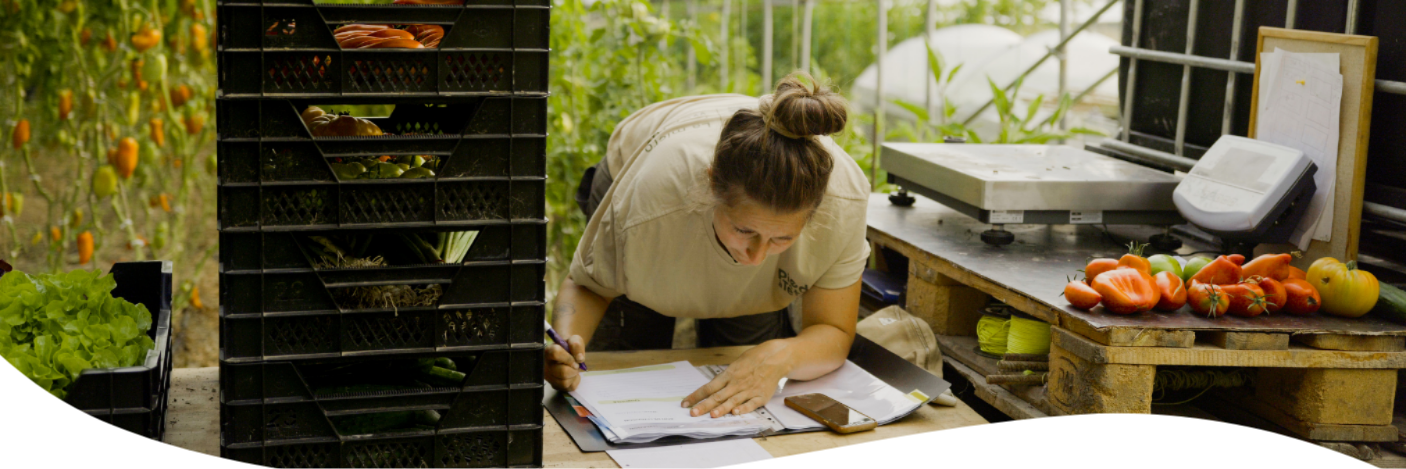
You know this better than anyone: using plant protection products on your farm is not just a matter of opening a container. It is a protocol. The product cabinet locked, ventilated, fitted with its retention tray. The protective equipment put on before touching anything at all. The product checked: authorisation number, original label, expiry date. The spray mix prepared according to the recommendations. The operation carried out. The cabinet locked again. The equipment rinsed.
All of that, you do properly. You know your obligations and you meet them. That is not where the problem lies.
The problem is double entry. You plan your operations in advance: plot, product, dose, crop growth stage, operator. You already have that information at the moment you plan. But once the operation has been carried out, you still have to open the notebook, find the right page, and write down again what you had already planned. A second time. And it is exactly that duplication that makes the record fall behind, build up gaps, and turn into a problem the day an inspector turns up.
Since 1 January 2026, the margin for error has narrowed further. Implementing regulation (EU) 2023/564 makes new fields mandatory in the treatment record. An incomplete record is no longer just a bad habit, it is a regulatory shortfall.
With PermaTechnics, planning becomes the treatment record. When you plan an operation (plot, product, dose, growth stage, operator) that information is entered once in the tool. On the day you carry the operation out, you confirm the task as done and adjust the actual data if needed. PermaTechnics feeds it into the record automatically. When an inspector turns up, you generate the export in a few clicks: a structured, time stamped PDF, ready to present, provided the information has been filled in properly over the course of the season.
What the regulations require
In Belgium and in France, every professional user of plant protection products has to record each operation. That obligation has existed since 2011 on the basis of regulation (EC) No 1107/2009. Since 1 January 2026, implementing regulation (EU) 2023/564 has tightened the requirements in both countries: new fields have become mandatory in the treatment record.
As for the format, the move to machine-readable digital form is set for 1 January 2027. In France, this is spelled out in the order of 24 December 2025 (Legifrance). In Belgium, on the Phytoweb portal of the FPS Public Health. In both cases, a scan or a photo of the paper record is no longer accepted.
A treatment record that complies in 2026 is no longer the same as one that complied in 2024. The fields have changed, and if you have not updated the way you record your entries, you may already be outside the rules.
What PermaTechnics generates, section by section
The logic is simple: the treatment record is not a document to be filled in on top of your work. It is the direct consequence of your daily use of PermaTechnics. Every operation planned and confirmed feeds the record automatically. When the time comes to present it, you generate the export: PermaTechnics compiles what you have entered throughout the season.
1. The farm
The first thing an inspector checks: whose record is this.
PermaTechnics anchors each export to an identifiable farm:
- Name of the farm and owner
- Full address
- Producer number
- Operator certification number (phytolicence in Belgium, Certiphyto in France)
In Belgium, the phytolicence is compulsory for anyone who buys, stores or applies plant protection products in a professional capacity. In France, the Certiphyto plays that role. In both cases, the certification number has to appear in the record so that whoever carried out each operation can be identified.
This information is entered once in the PermaTechnics profile and appears automatically on every export.
2. The plots
The treatment record is organised by growing area: blocks, greenhouses, gardens. Each one has its own area in m² and its list of active plantings.
That plot structure answers directly to the requirement to locate each operation precisely, one of the first points checked during an inspection.
3. The crops in the ground
For each batch, PermaTechnics records a complete sheet:
|
Field |
Example |
|
Crop |
Broccoli |
|
EPPO code |
BRSOK |
|
Variety |
Belstar |
|
Sowing date |
17 May 2026 |
|
End of planting date |
8 August 2026 |
|
Location |
Block 1 (P1) |
|
Area |
1.5 m² |
The EPPO code is the standardised reference imposed at European level by regulation 2023/564 to identify crops. It is published and kept up to date by the European and Mediterranean Plant Protection Organization.
4. The history of the last 5 years by location
For each plot, PermaTechnics automatically reconstructs the crops that have followed one another there over five years: crop, variety, EPPO code, start and end dates.
This makes it possible to justify the crop rotations on your farm, an item checked during inspections, in particular as part of the guide to good practice in vegetables (CIM Wallonie).
5. The log of plant protection treatments
This is the heart of the treatment record. For each treatment recorded, PermaTechnics separates the fields required by the regulations from the additional fields that are useful for follow-up and for inspections, in line with regulation 2023/564:
|
Field |
What it contains |
Status |
|
Date |
Exact day of the operation |
Mandatory 2011 |
|
Product used |
Trade name of the product |
Mandatory 2011 |
|
Dose |
In g/m², L/plant or plants/m² |
Mandatory 2011 |
|
Plot |
Reference of the growing area |
Mandatory 2011 |
|
Crop treated |
EPPO code |
Mandatory 2011 |
|
Area treated |
In m² |
Mandatory 2026 |
|
Type of use |
Open field / under cover |
Mandatory 2026 |
|
Crop growth stage |
In line with the BBCH scales |
Mandatory 2026 |
|
Authorisation number |
Permit number of the product |
Mandatory 2026 |
|
Target |
Pest or objective aimed at |
Mandatory 2026 |
|
Basis for the decision |
Why this treatment was decided on |
Mandatory 2026 |
|
Weather |
Conditions at the time of application |
Mandatory 2026 |
|
Operator |
Who carried out the operation |
Mandatory 2026 |
|
Effectiveness of the treatment |
Result observed |
Additional |
|
Notes |
Free observations |
Additional |
The basis for the decision (why you treated: alert threshold, visual observation, preventive treatment) is one of the fields most often left empty in paper records. It is also one of the first to be checked during an inspection.
What PermaTechnics does not do for you
PermaTechnics structures and exports your treatment record. Compliance depends on the quality of what you enter:
- The operator certification number has to be filled in on your profile (phytolicence in Belgium, Certiphyto in France)
- The authorisation number of each product has to be entered for each treatment
- The crop growth stage, the basis for the decision and the weather conditions have to be filled in at the time of the operation, not pieced back together afterwards
A good tool plus good discipline: that is the combination that gets you through an inspection without stress.
In summary
|
What the inspector checks |
What PermaTechnics generates |
|
Identity of the farm and operator certification |
Automatic from the profile |
|
Precise location of each plot |
Structured by growing area |
|
Crops in the ground with EPPO code |
A sheet per crop batch |
|
Rotations over 5 years |
Automatic history by location |
|
Complete log of plant protection treatments |
Mandatory 2026 fields included |
Sources
- Regulation (EC) No 1107/2009, obligation to keep a record (art. 67)
- Implementing regulation (EU) 2023/564, content and format of records
- Phytoweb (FPS Public Health, Belgium), use record and timetable
- FPS Public Health Belgium, phytolicence
- Legifrance, order of 24 December 2025 (France)
- Service-public.fr, Certiphyto (France)
- CIM Wallonie, guide to good practice in vegetables