
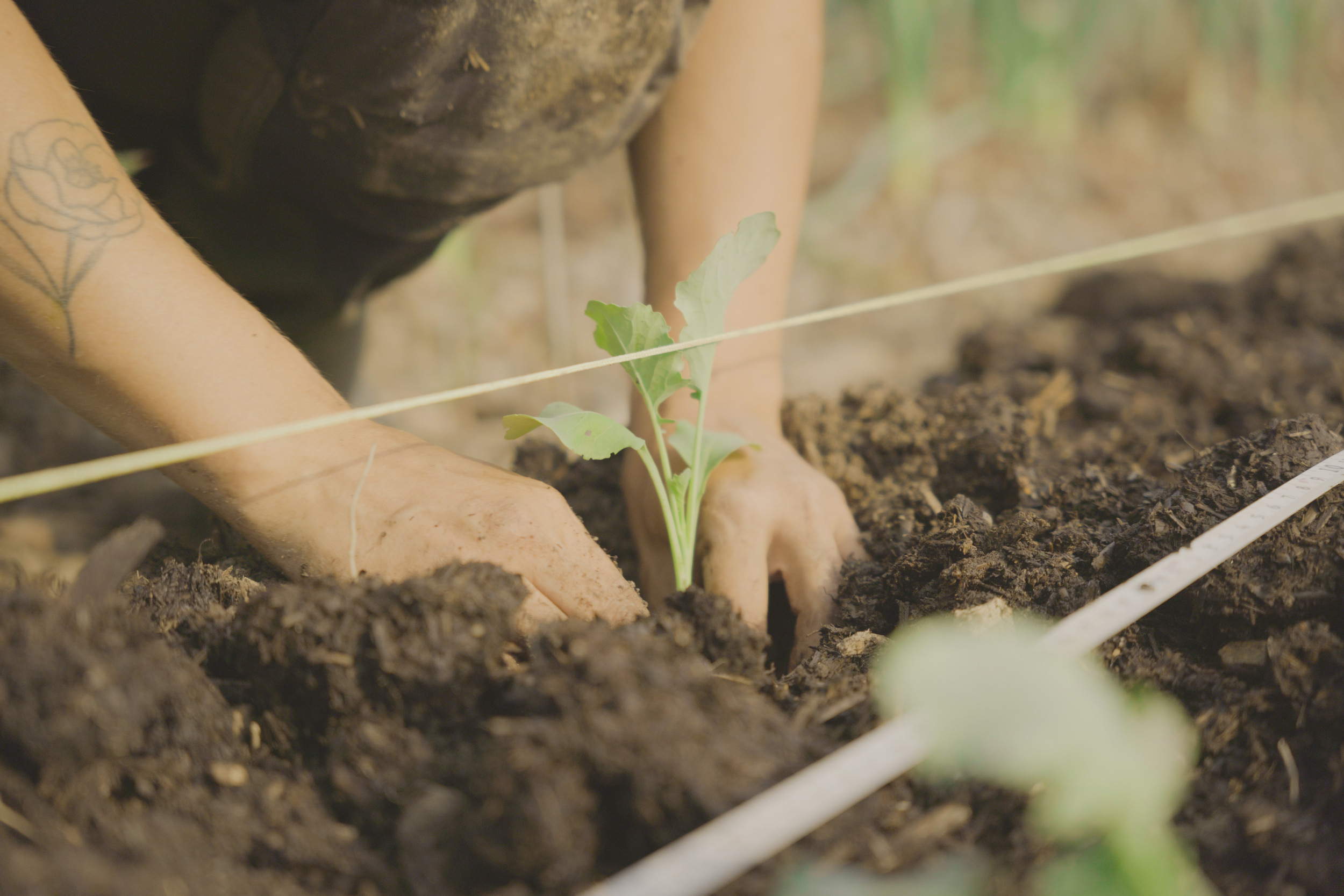
Some ideas germinate slowly, in the shade, before finding their way to the light. PermaTechnics is one of those projects that took the time to mature, to root itself in the real world before coming up.
2015 – The time of the first seeds
A documentary. “Demain”. For Jean-Marie, the future creator of PermaTechnics, that film acts as a trigger. Alternative models, permaculture among them, are not a distant utopia but a living, concrete practice. A way of growing that regenerates instead of exhausting.
The wish had been there for a long time: to contribute to something bigger than small everyday gestures. Eating organic is good. Cutting down on meat too. But how do you really tip the scales? How do you turn that vague wish into concrete action?
2020-2022 – Immersion in the soil
Two years spent studying growing practices. Listening. Understanding. What the emerging team discovers shapes the project to come.
Meetings with market gardeners who left everything behind to grow differently. Engineers turned farmers. City dwellers who chose the land. All of them carry the same vision: feed people without destroying. Regenerate exhausted soils. They know that agriculture accounts for a far from negligible share of greenhouse gas emissions (20 to 30%). They know about the waste of nitrogen inputs: 90% end up in the water table or in the atmosphere as nitrous oxide, a gas that warms 296 times more than CO2.
They also know that greater crop diversity on smaller areas, combined with a well thought out rotation and areas broken up by hedges, is the way forward. It means less soil erosion, fewer pests and soil that is naturally richer in nutrients without excessive inputs.
But here is the reality:
- Days that stretch to 70 or 80 hours a week
- Scattered or poorly suited software solutions, and a heavy administrative load
- Pay that does not match the commitment
- Many who give up, exhausted
The paradox is a painful one: those who want to transform agriculture are too snowed under to organise themselves effectively and to spend more time on what matters most in their eyes.
When the pieces of the puzzle come together
That is where the paths cross. Years spent in the world of software can be put to work for this cause. If time is the problem, technology can become part of the solution.
Didrik arrives with his technical knowledge and his vision for planning algorithms. Nicolas comes in to steer the many sided day to day running of the company. Morgan brings his own experience as a market gardener, hands that know the soil and a curiosity for testing every tool on the market. The team takes shape, each with his piece of the puzzle.
The idea becomes clearer:
- Simplify crop planning, while making it more effective
- Automatically organise the tasks that follow from it
- Make the administrative paperwork (which will only get heavier) and the bookkeeping tasks easier
- Give a summary view of turnover and expected profitability at every iteration or change to the planning
- All of it in a simple, accessible tool, designed for the field
A tool by and for market gardeners
Morgan draws on his own experience: planning a season takes a considerable amount of time, and the application saves a large number of hours. That time saved is energy freed up for what really counts: the quality of the crops, observing living systems, improving practices, quality time with the family, and of course better profitability in the end.
PermaTechnics does not claim to change the farming world with a wave of a magic wand. The ambition is more down to earth: to free up a few hours a week. A few hours that can make the difference between holding on and breaking down. Between enduring and building.
Starting local to spread further
The choice made itself: start with Belgian market gardeners. Understand them, their land, their specific constraints. Solutions from elsewhere exist, but they do not always fit the realities here.
Regenerative agriculture remains an ideal. But you do not change practices simply by wishing for revolutions. You change them by making daily life run more smoothly. By freeing up time and energy so that everyone can, at their own pace, move their way of growing forward.
The project keeps growing, fed by one simple conviction: making daily life easier for those who feed us is looking after our common future.
PermaTechnics is about to see the light of day. An application born of the meeting between technology and the land, between efficiency and respect for living systems.
Coming next: how do you turn a vision into a concrete tool? Behind the scenes of the development.