
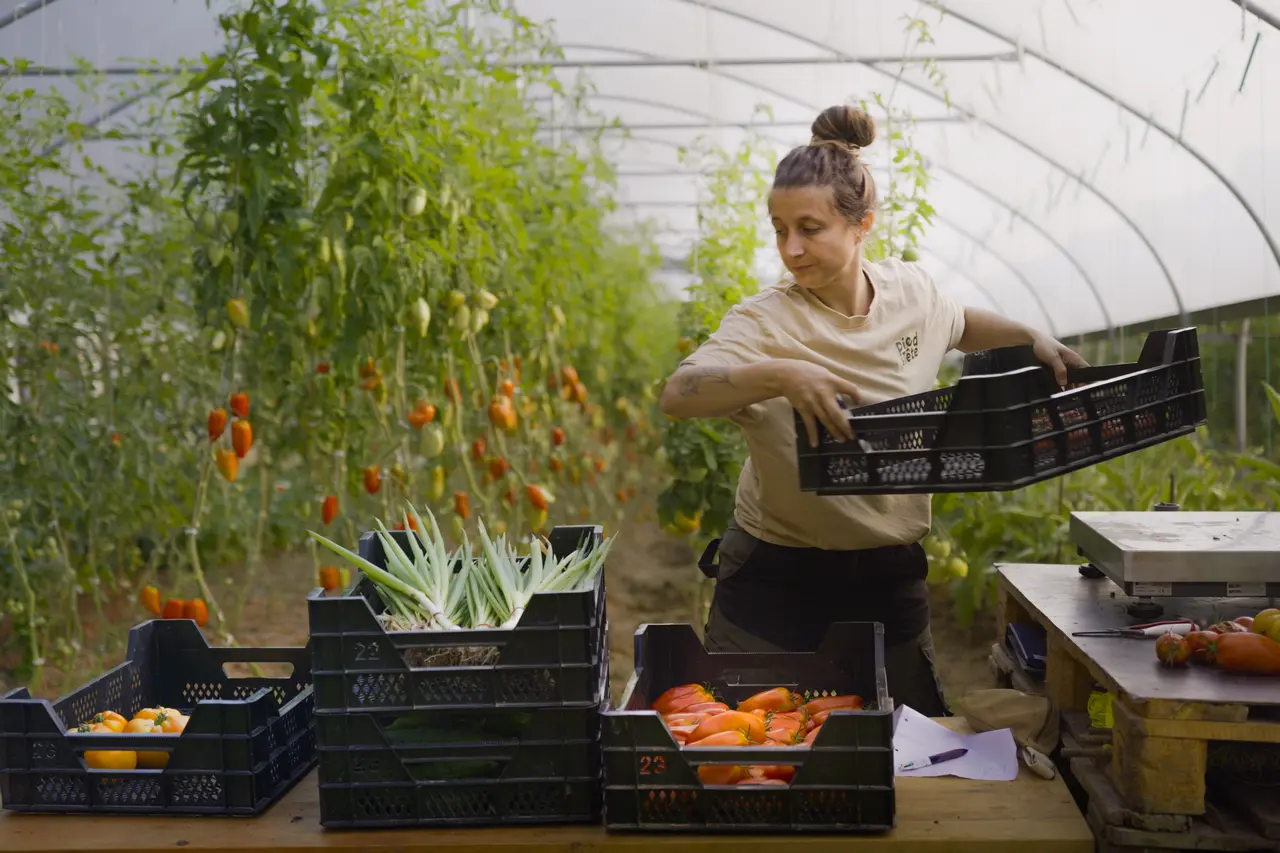
We went to meet Joffrey, manager of the Färm Mont-Saint-Jean in Braine l’Alleud, to understand how customers interact with fruit and vegetables in his shop. A no filter conversation that brings out some valuable lessons for market gardeners.
How much the look of the produce matters in store
“Consumers have got used to seeing graded produce, always beautiful” Joffrey observes. “Beans that are all green, all firm, without a single mark on them, that sells a lot more straight away”.
There is a reason for that demand on appearance: the customers of organic shops come mostly from the supermarkets, with well established habits of graded produce. A fact that is sometimes frustrating, but unavoidable if you want to understand how selling works.
The -50% tree, adapting to how customers behave
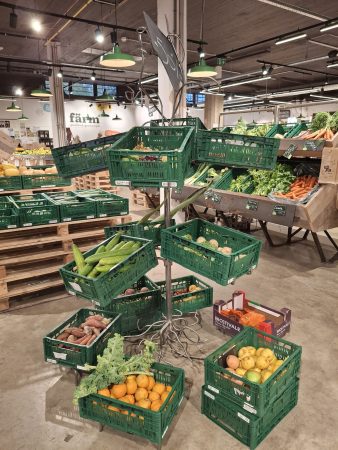
Faced with that reality, Joffrey came up with an original solution, his “-50% tree”, a metal structure made by a local metalworker. “As soon as we have a product on a shelf that is a little less good looking, the customer will not pick it. Better to take it out straight away and sell it quickly before it really does go off.”
The idea created a real phenomenon: “Word really did get around that my shop is super fresh. There are people who come just for that.” Another benefit, it brings in new customers who can then eat organic fruit and vegetables at a lower price.
To round off the display, a small explanatory sign helps customers understand the thinking: making the most of produce that is “still perfectly edible” rather than throwing it away. Explaining is essential to avoid some customers reading it the wrong way.
Local produce, a strong argument
Local origin remains a powerful commercial lever, even against irregular grading. Joffrey gives a concrete example with apples: “I have 10 different kinds of apple in the shop, and 2 of them come from Terres de la Cala. On the sign you can see BE, and they go very, very well.”
That preference for local produce goes beyond the usual visual criteria. Customers are happy to accept less standardised shapes when they know they are supporting the local economy.
Tastings: bringing out the hidden qualities
In-store events are another way of getting past the visual criterion. A mushroom grower “with a difficult look” and high prices turned the situation round by coming in to cook on several Saturdays: “People tasted them. When you bring in taste with a little show in the shop, people get very curious.”
The effect carries on beyond the event itself. The shop team, having tasted the produce themselves, become ambassadors: “The teams then recommend it to customers too.” That passing on of experience creates a chain of trust that more than makes up for the way the produce looks.
For a market gardener, it is hard to escape what the trade expects in terms of grading. There are, on the other hand, ways of making sure it is not the only factor. To get full value from your produce, explaining, local roots and the experience of taste are powerful levers.